Globe-trotting ancient ‘sea-salamander’ fossils rediscovered from Australia’s dawn of the Age of Dinosaurs
Shedding light on the earliest global radiations of land-living animals adapting to life in the sea.
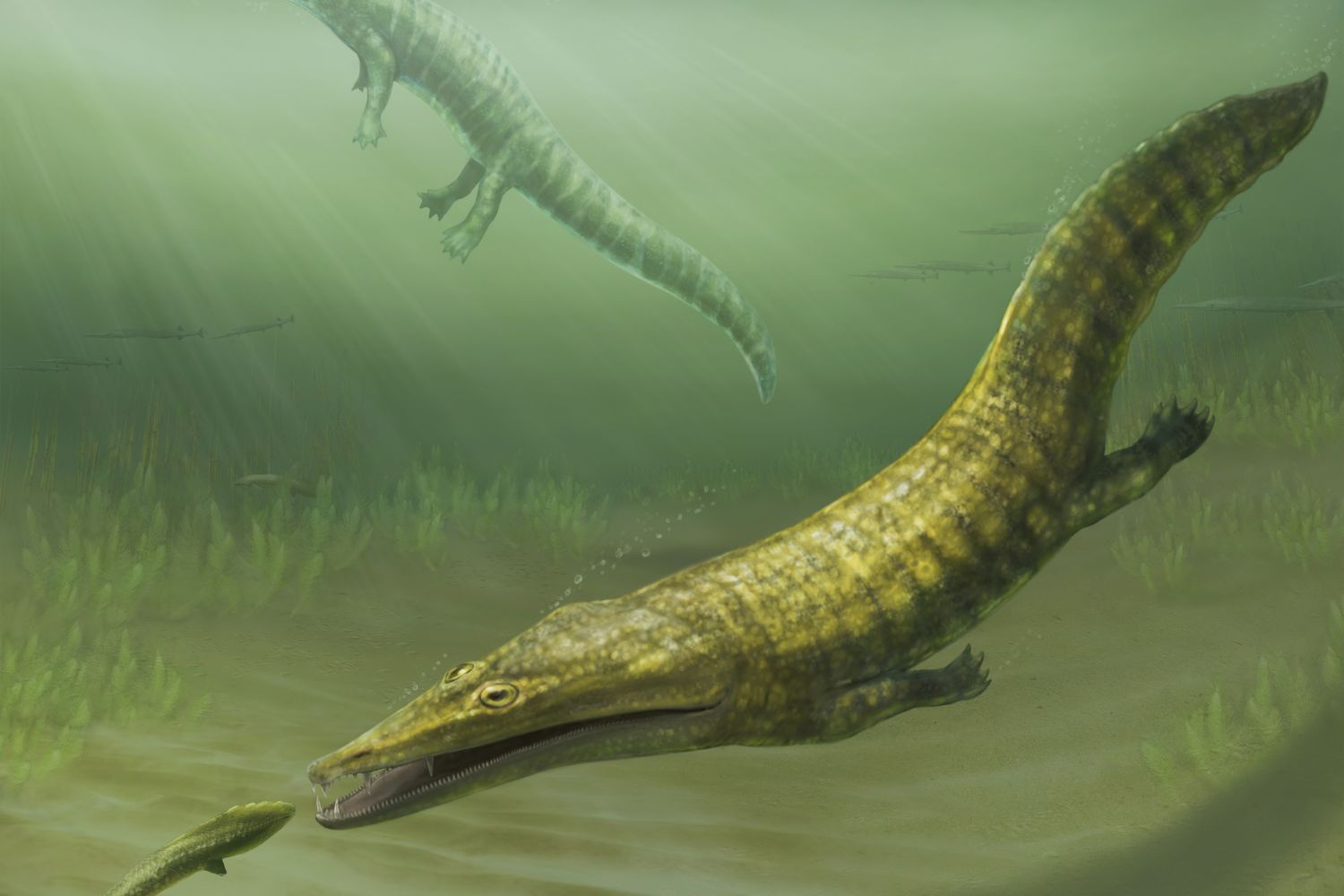
Ancient marine amphibians. Credit: Pollyanna von Knorring, the Swedish Museum of Natural History
Around 250 million years ago, what is today scorching desert in remote northwestern Australia was the shore of a shallow bay bordering a vast prehistoric ocean. Fossils recovered from this region over 60 years ago, and almost forgotten in museum collections, have now shed new light on the earliest global radiations of land-living animals adapting to life in the sea.
The cataclysmic end-Permian mass extinction and extreme global warming prompted the emergence of modern marine ecosystems at the beginning of the Age of Dinosaurs (or Mesozoic era), some 252 million years ago. This landmark evolutionary event involved the earliest appearances of sea-going tetrapods (limbed vertebrates), including both amphibians and reptiles, which quickly rose to dominance as aquatic apex-predators. To date, the fossils of these earliest sea monsters have been largely documented from the northern hemisphere. By comparison, southern hemisphere records are geographically sparse and incompletely known.
A new study of 250 million-year-old fossil remains from the iconic Kimberly region of far northern Western Australia has uncovered evidence of a surprisingly diverse marine amphibian community with unexpectedly worldwide trans-oceanic links.
Finding lost fossils
Ancient marine amphibian fossils were initially discovered in Australia during scientific expeditions undertaken in the early 1960s and 1970s. The recovered specimens were distributed between museum collections in Australia and the U.S.A. Their resulting research was finally published in 1972, and identified a single species of marine amphibian, Erythrobatrachus noonkanbahensis, named from several skull fragments found weathering out of a rock outcrop on Noonkanbah cattle station east of the isolated Kimberly township of Derby.
Unfortunately, the original fossils of Erythrobatrachus were lost sometime during the intervening 50 years. This launched a search through international museum collections, which culminated with the rediscovery and reassessment of these enigmatic ancient marine amphibian remains in 2024.
Revealing cryptic communities and global radiations
Erythrobatrachus was a trematosaurid temnospondyl. Trematosaurids were superficially ‘crocodile-like’ relatives of modern salamanders and frogs that grew up to 2 m in length. Trematosaurids are important because their fossils occur in rock deposits laid down as sediment in coastal settings from less than 1 million years after the end-Permian mass extinction. They are, therefore, the geologically oldest currently recognisable group of Mesozoic marine tetrapods.
Surprisingly, however, detailed re-study showed that the skull fragments of Erythrobatrachus did not all belong to a single species. Rather, they represented at least two distinct types of trematosaurids – Erythrobatrachus and another species attributable to the well-known genus Aphaneramma.
Examination of the Erythrobatrachus skull using high-resolution 3D imaging suggests that it was about 40 cm long when complete, and came from a large-bodied, broader-headed top-predator. On the other hand, Aphaneramma was about the same size but had a long thin snout for catching small fish. Both of these trematosaurids swam through the water column, but would have hunted different prey in the same habitat.
Furthermore, while Erythrobatrachus in known exclusively from Australia, fossils of Aphaneramma have been reported from similar aged deposits on Svalbard in the Scandinavian Arctic, the Russian Far East, Pakistan and Madagascar. The Australian trematosaurid remains thus show that these earliest Mesozoic marine tetrapods not only radiated rapidly into a range of ecological niches, but also managed to disperse worldwide, perhaps following the coastal margins of interconnected supercontinents during the first two million years of the Age of Dinosaurs.
The paper is published in the Journal of Vertebrate Paleontology. The rediscovered fossils of Erythrobatrachus are currently being repatriated to Australia. Other ancient amphibian fossils from the Age of Dinosaurs are on public display at the Swedish Museum of Natural History.