Researchers name, describe new crocodile that hunted iconic Lucy’s species
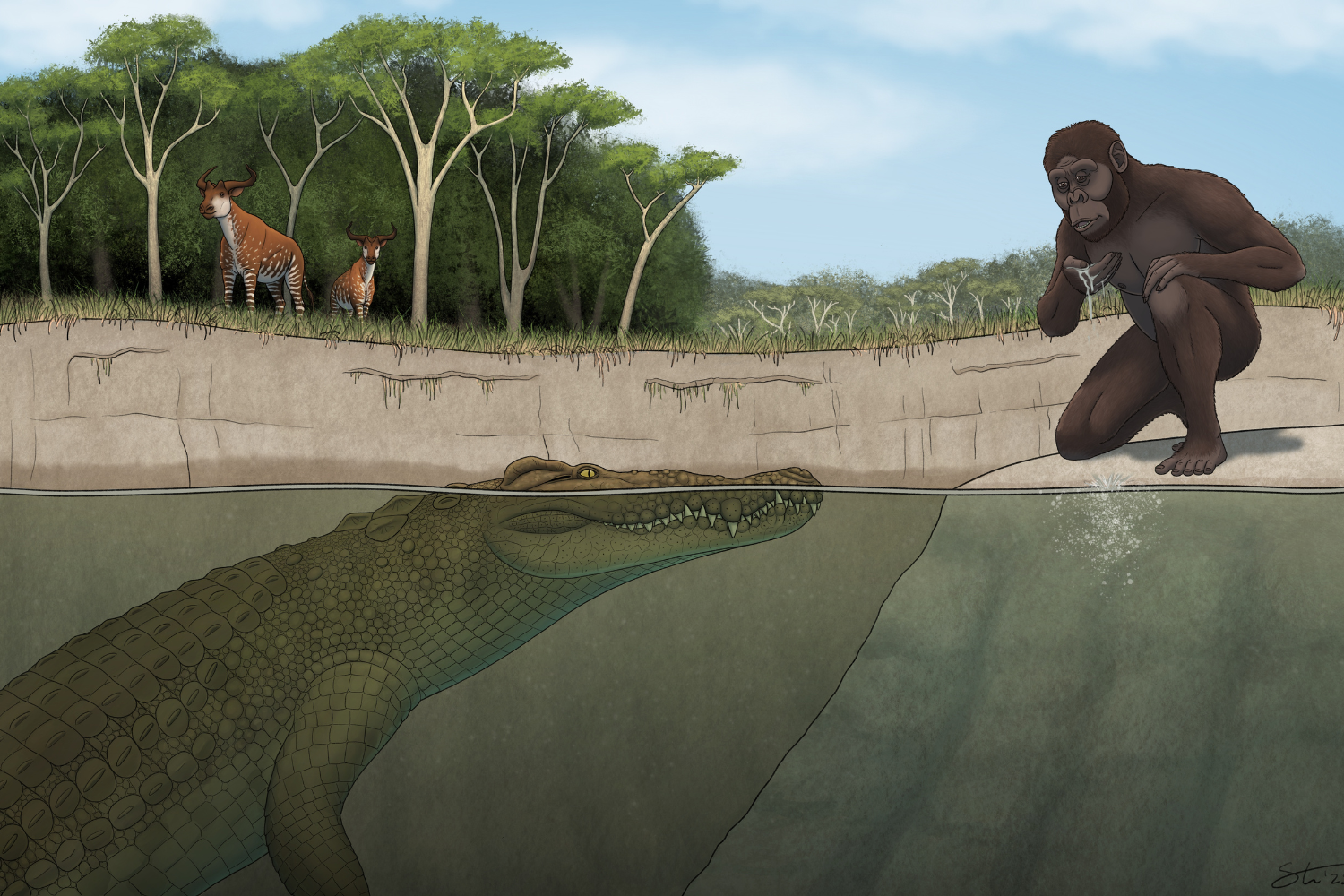
Photo credit: Tyler Stone, University of Iowa.
More than 3 million years ago, when our ancient ancestors embodied by the iconic Lucy were roaming the African landscape, they would have feared a big, bad crocodile with a prominent lump on its head, patiently lurking in rivers and lakes to attack them.
That crocodile is a new species, a research team led by the University of Iowa has determined. In a new study, published in the peer-reviewed Journal of Systematic Palaeontology, the researchers describe the species and give it a name: Crocodylus lucivenator, or Lucy’s hunter.
The name seems quite appropriate. The ancient reptile lived between 3.4 million to 3 million years ago, overlapping the time period and the region in Ethiopia with Lucy and her hominin species, Australopithecus afarensis. Lucy’s skeleton, discovered in 1974, is noteworthy because it was the oldest and most complete early human ancestor or relative ever found. It also provided further evidence that, in human evolution, walking on two legs, or bipedalism, preceded increased brain size.
The newly named crocodile ranged from 12 to 15 feet in length and adults weighed between 600 and 1,300 pounds. It was a dominant creature and the only crocodile on the landscape — an expanse of shrubland and wetlands pocked with rivers lined with trees. It was an ambush predator, the researchers say, silently submerged in the water, poised to spring on those who came around for a drink.
“It was the largest predator in that ecosystem, more so than lions and hyenas, and the biggest threat to our ancestors who lived there during that time,” says Christopher Brochu, professor in the Department of Earth and Environmental Sciences at Iowa and the study’s corresponding author. “It’s a near certainty this crocodile would have hunted Lucy’s species. Whether a particular crocodile tried to grab Lucy, we’ll never know, but it would have seen Lucy’s kind and thought, ‘Dinner.’
Brochu has been studying ancient crocodiles for the past 35 years. He first looked at the Crocodylus lucivenator specimens when he visited a museum in the Ethiopian capital Addis Ababa in 2016.
“I was just blown away because it had this really weird combination of character states,” Brochu recalls.
Notable among the crocodile’s peculiar physical traits was the large hump in the middle of its snout, similar to what is found on the American crocodile but not seen with the Nile crocodile in Africa. The researchers think the hump was used by the male crocodiles to attract a mate.
“You see this in some modern crocodiles,” Brochu says. “The male will lower his head down a little bit to a female to show it off.”
Lucy’s hunter also had a snout that extended further from its nostrils than other crocodiles at that time, and that more closely resembles the lengthened snout in modern crocodiles, the researchers report.
The researchers examined 121 cataloged remains — primarily skulls, teeth, and parts of jaws — representing dozens of individuals. The fossils were excavated from the Hadar site in the Afar region of Ethiopia. The region for decades has produced bountiful finds linking humanity’s ancestral past, including Lucy and her ilk, and was designated a UNESCO World Heritage site in 1980.
While most fossils were fragments requiring the researchers to extrapolate the full skeleton, one specimen had several partially healed injuries on its jaw that suggested it had tussled with one of its peers, according to Stephanie Drumheller, teaching associate professor at the University of Tennessee who earned a doctorate at Iowa.
“The fossil record preserves similar injuries in extinct groups as well, so this kind of face-biting behavior can be found throughout the crocodile family tree,” says Drumheller, a study co-author. “We can’t know which combatant came out on top of that fight, but the healing tells us that, winner or loser, this animal survived the encounter.”
While there were at least three other crocodile species just south in the region, known as the Eastern Rift Valley, the Lucy’s hunter crocodile appeared to have its territory in Hadar to itself.
“During the Pliocene, Hadar was composed of a variety of habitats alongside its lake and river systems over space and time, including open and closed woodlands, gallery forests, wet grasslands, and shrublands,” says Christopher Campisano, associate professor in the School of Human Evolution and Social Change at Arizona State University and a study co-author. “Interestingly, this crocodile was one of only a few species that was able to persist throughout.”