Heron-like, fish-eating dinosaur from 70 million years ago discovered in Argentina
Palaeontologists estimate that the new species — described based on fossils unearthed at a ranch in Argentina — grew up to three metres long
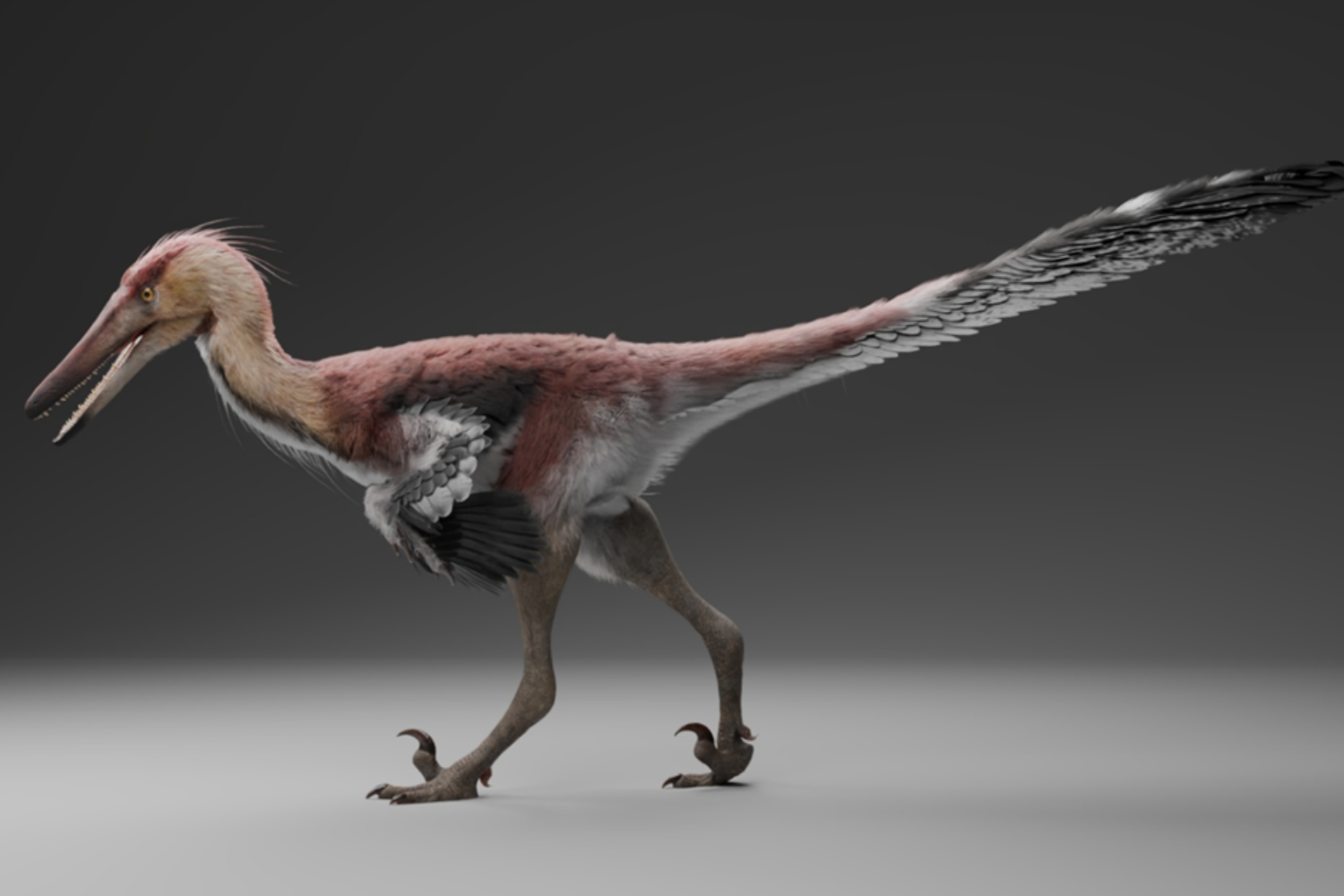
A reconstruction of Kank australis by Gabriel Díaz Yantén
A new raptor-like dinosaur from some 70 million years ago that ate fish and behaved like modern herons has been unearthed from southern Patagonia.
The new species, which has been named Kank australis, was identified based on the discovery of fossil remains including teeth, vertebrae and toe bones.
K. australis is an unenlagiid, a family of small-to-medium sized theropod dinosaurs whose members have been unearthed from Late Cretaceous deposits in South America, Antarctica, Australia and Madagascar.
Based on comparison with another unenlagiid — Neuquenraptor argentinus, which lived in northern Patagonia 90 million years ago — researchers believe adults of the new species likely grew up to some 2.5–3 metres long.
The new species is described by palaeontologist Dr Matías Motta, of the Bernardino Rivadavia Natural Sciences Museum in Buenos Aires (Museo Argentino de Ciencias Naturales “Bernardino Rivadavia”), and his colleagues in a paper published today in the peer-reviewed Journal of Vertebrate Paleontology.
“Kank lived in a landscape of meandering rivers and streams with seasonal ponds, inhabited by aquatic plants such as water lilies and animals including fish, insects, and various molluscs,” says Dr Motta.
Based on the analysis of ancient soil samples and fossilised plant remains, he explains, we know that “70 million years ago the climate was temperate and humid, with seasonal rainfall, very different from the current cold and relatively dry conditions.”
Analysis of the fossilised remains of the new dinosaur, meanwhile, has shined light on how it might have lived.
“The cervical vertebrae of Kank show special structures for muscle attachment and the protection of neck blood vessels — features particularly important in modern birds with complex neck movements, such as herons,” says Dr Motta.
“This suggests Kank may have been an active fisher, contrasting with common portrayal of raptors as agile terrestrial predators, like Velociraptor from the Northern Hemisphere.”
The discovery also helps fill in some more of the patchy evolutionary history of the unenlagiids in South America. While seven different species have been recorded in northern Patagonia, until now the fossil record had only yielded a few isolated remains from the south of the region that palaeontologists were unable to attribute to particular species.
“Kank helps bridge a distributional gap for the Late Cretaceous of southern Patagonia, connecting known records from northern Patagonia and Antarctica, and showing that this family was dispersed across different latitudes of South America.”
K. australis was unearthed at La Anita farm, near the city of El Calafate, in Santa Cruz, Argentina.
“Field excavations have been conducted there since 2018, uncovering a wide variety of fossil animals and plants,” says Dr Motta.
“The first remains of Kank were discovered in 2018, but were too fragmentary to be identified as a new species,” he adds. “Subsequent expeditions recovered additional material, with the discovery of a cervical [neck] vertebra in 2024 proving key to recognising it as a new unenlagiine dinosaur.”
Like other unenlagiids, Dr Motta explains, K. australis sports an enlarged, ‘raptorial’ claw on the second toe of its foot.
“However,” he adds, “it differs in having teeth with sharp and pronounced longitudinal ridges and notably pneumatic cervical vertebrae (with internal air chambers).”
“It is also smaller and more gracile compared to other unenlagiids from the end of the Cretaceous, such as Austroraptor cabazai, a giant (around five metres long) unenlagiine from northern Patagonia.”
The discovery of the new dinosaur adds to mounting evidence that unenlagiids were piscivores — that is, fish-eaters.
“Their elongated snouts, numerous teeth and long, flexible necks suggest adaptations for fishing, similar to modern herons,” Dr Motta explains.
“In the case of Kank, its remains were found alongside fish fossils, reinforcing this idea.”
However, the palaeontologist notes, it is possible that Kank also preyed on other animals that lived in the same ecosystem, which included frogs, lizards, turtles, and even mammals like Patagorhynchus pascuali, a semi-aquatic monotreme related to modern echidnas and platypuses.
“Kank coexisted with larger carnivores such as Maip macrothorax, a formidable megaraptorid dinosaur more than 10 metres long, which may have been capable of preying upon it,” Dr Motta adds.
The genus of the newly discovered species pays homage to a myth of the Aonikenk, the southernmost group of the indigenous Tehuelche people of Patagonia.
“Kank refers to an old giant rhea [a large, flightless South American bird] whose powerful running steps left the imprint of its toes in the sky, forming the constellation known as Choiols,” explains Dr Motta.
“In Latin, this constellation is called Crux, the Southern Cross — which points toward the southernmost region of the planet, where Kank was discovered.”
Similarly, the species name — “australis”, literally “from south” — is also a nod to the latitude of the discovery.
With their initial study complete, the researchers are planning further digs into the Chorrillo Formation.
“The site where Kank was discovered has provided extensive information about the Late Cretaceous environment of southern Patagonia, so continuing excavations there is crucial,” explains Dr Motta.
“Finding more Kank fossils will help us better understand its biology and ecological role.”
In the meantime, the team are also studying new fossils from four sites in northern Patagonia.
“These findings indicate that unenlagiids were widely distributed during the Late Cretaceous,” Dr Motta says.
He adds: “We are particularly interested in investigating the environments they colonised and speciated in — especially in ecosystems dominated by large apex predators such as abelisaurids and megaraptorans.”