New Zimbabwean dinosaur species named by Museum scientist reveals Africa’s hidden history
Musango matusadonaensis was discovered on the shores of Lake Kariba in Zimbabwe.
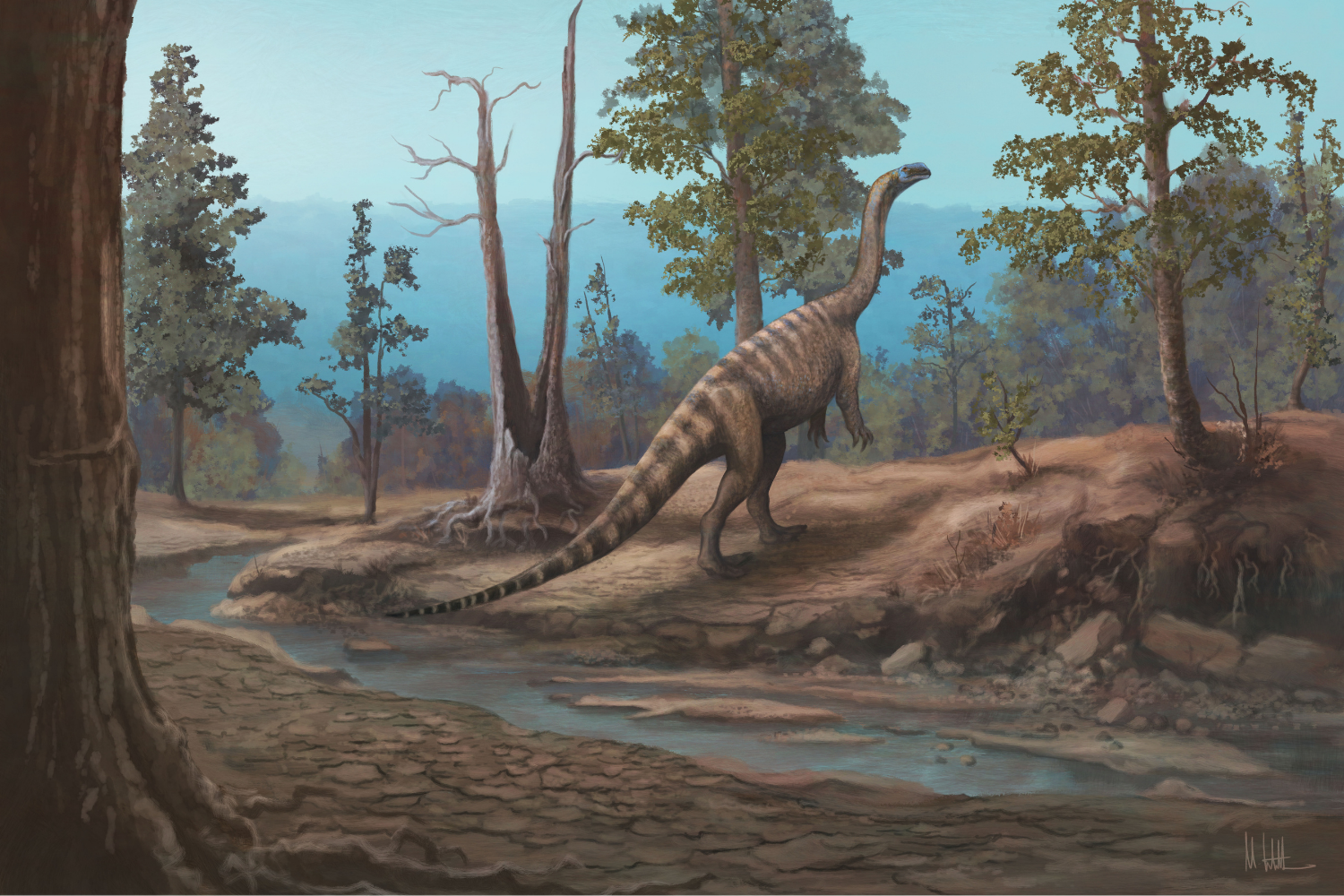
An artist’s reconstruction of Musango matusadonaensis walking in a wooded area near a stream. © Mark Witton 2026
- Musango matusadonaensis was discovered on the shores of Lake Kariba in Zimbabwe.
- The 4.5-metre-long dinosaur lived in the Late Triassic around 210 million years ago and weighed an estimated 222 kilogrammes.
- Musango is a sauropodomorph, an early relative of dinosaurs such as Diplodocus that walked on two legs rather than four.
A newly discovered dinosaur is shining a light on an important moment in the evolution of dinosaurs.
Discovered on the shore of Lake Kariba in Zimbabwe, Musango matusadonaensis opens a window into the Late Triassic around 210 million years ago. This was the time dinosaurs were beginning to spread around the planet as they moved towards becoming Earth’s dominant animals.
Understanding how dinosaurs moved from being a relatively small part of life in the Triassic to a major part of the Jurassic and Cretaceous ecosystems that followed is still a major area of research. Fossils from Africa may hold the answer, as they have historically been understudied compared to sites in Europe and North America.
A team of British, South African and Zimbabwean scientists have been working to change this as part of research in Zimbabwe. The team previously named Musankwa sanyatiensis as just the fourth dinosaur ever described from the country in 2024, with Musango now the fifth.
Unlike Musankwa, Musango is fairly complete for its age and bones from the spine, ribs, arms, legs and feet have been discovered. Analysis of its fossils suggest Musango was around eight years old and almost fully grown at the time of its death, and had previously recovered from a serious infection or injury.
It’s estimated that Musango would have been around 4.5 metres long when it died, which is about the size of a car. However, it was quite lightly built at just 222 kilogrammes – similar to a fully grown pig. While the dinosaur’s skull is missing, it’s likely to have been a herbivore or omnivore.
It would have fed on plants growing alongside rivers and streams in ancient Zimbabwe, and lived with lungfish and crocodile-like phytosaurs as well as other dinosaurs such as Musankwa. Further studies of the region are likely to reveal more species previously unknown to science.
Professor Paul Barrett, Merit Researcher at the Natural History Museum, London, and the study’s lead author, says: “Until recently, it was assumed that the dinosaurs living across southern Africa were largely the same,” he explains. “However, these discoveries are showing that this part of the ancient supercontinent Gondwana was actually made of a series of smaller ecosystems – each with a different cast of characters.”
“It suggests that what we’ve found so far is only the tip of the iceberg. We’ve already got one other new species that we’ve yet to describe, while our team has been told about other fossils from the region that we’ve yet to look at. I think it’s likely there are even more dinosaurs still to be found there.”
Professor Jonah Choiniere, leader of the expedition and a co-author from Johannesburg’s Evolutionary Studies Institute, adds: “New dinosaur species like Musango show the value of doing palaeontological fieldwork in remote, and often scenically beautiful, places.”
“This study is the result of a thriving international collaboration between the UK, South Africa and Zimbabwe, and reinforces the importance of southern Africa in understanding dinosaur diversity.”