Post-pandemic cycling boom in major cities, as cyclist safety improved thanks to more and better cycling infrastructure
Findings of new study – released as fuel prices for motor vehicles soar internationally – include fatality rates dropping, per 10 million trips, by 88% in Paris, 82% in London and 62% in New York City
This additional information is included as part of a press release labeling system introduced by the Academy of Medical Sciences and Science Media Centre. For more details click here.
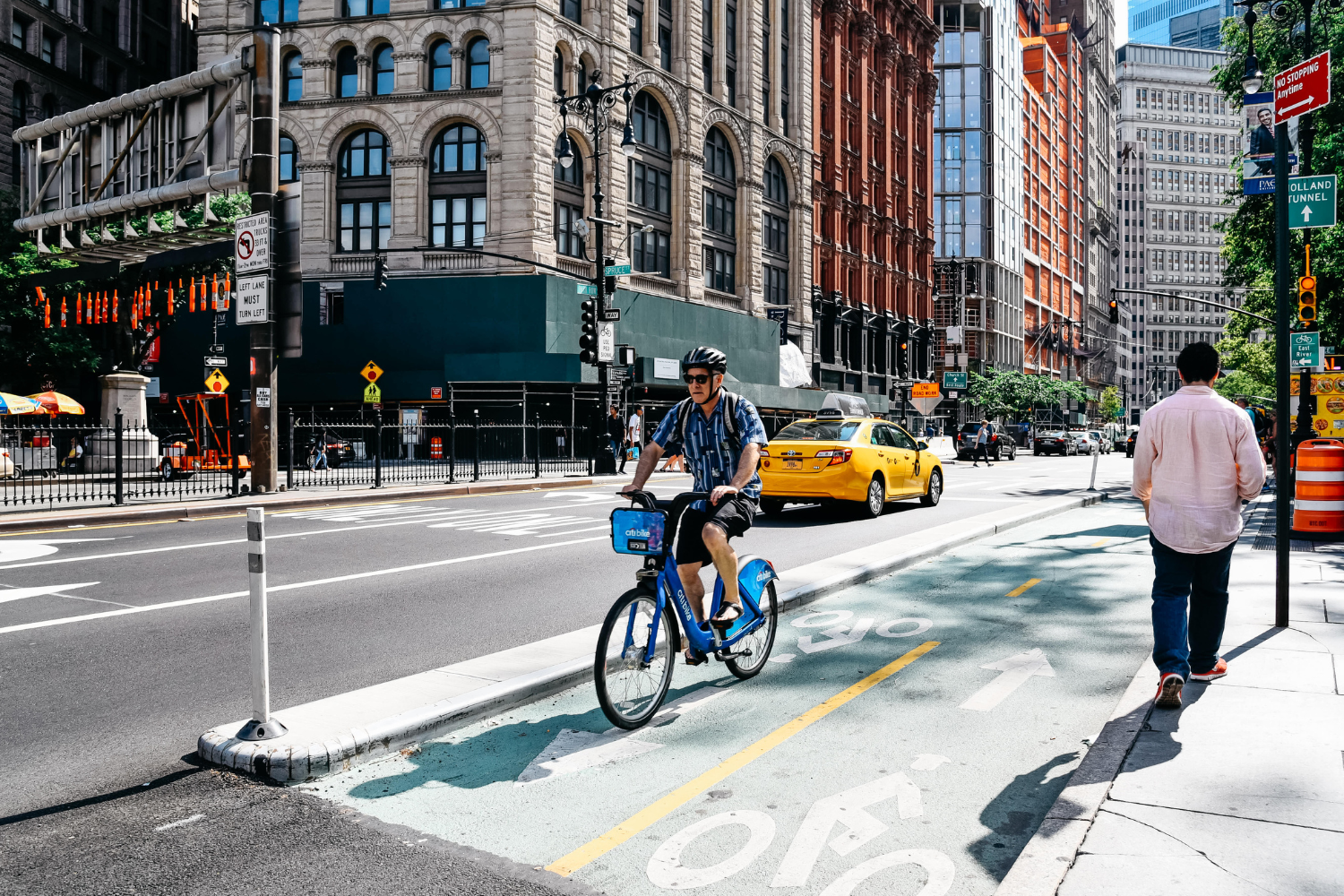
Photo by Architect´s Eye for Alamy
Cycling in some of the world’s largest cities has continued to increase since the pandemic, thanks to safer and improved infrastructure which is also leading to a drop in fatality rates.
Tracking data from 2005 to 2023, the findings document fatality rates falling per-trip by 88% in Paris, 82% in London, 62% in New York City (NYC), and 37% in Berlin, per 10 million bicycle trips.
The cyclist serious injury rate fell by 62% in NYC, 50% in London, and 37% in Berlin.
These results have been achieved amid a historic rise in the percentage of daily trips made by bicycle in all these cities. Paris, for example, witnessed the most dramatic transformation, with the share of journeys made by bicycle surging from 5% in 2019 to 11% by 2023; more than doubling in just four years.
The release of the paper, published earlier this month in the peer-reviewed International Journal of Sustainable Transport, is particularly timely as fuel prices for motor vehicles continue to soar internationally.
“The ‘bike boom’ sparked by COVID-19 lockdowns was not a temporary phase; it has now become a permanent shift in how urban populations move,” explains lead author and internationally renowned expert, Ralph Buehler, Professor in Urban Affairs and Planning, at Virginia Tech. The international team of co-authors included John Pucher, Rutgers University, Marcel Moran, San Jose State University, Rachel Aldred, University of Westminster, and Emmanuel de Lanversin, French Ministry of Transport.
“While cycling levels had been increasing for three decades prior to 2019, the post-pandemic period saw an unprecedented acceleration in Paris and continued increases in the other three cities.
“Our results point to a ‘safety in numbers’ effect where instead of more injuries and fatalities occurring due to more trips, the opposite has occurred.
“In all four cities, the cornerstone for this achievement has been made through the expansion and improvement of cycling infrastructure, especially a focus on cycleways separated from motor vehicle traffic.
“As experience in these cities shows, it is crucial that cycling infrastructure be integrated into a continuous network.
“Traffic calming of residential neighbourhoods has been a key measure to reduce the volumes and speeds of motor vehicle traffic, thus making cycling less dangerous and more pleasant. That has been extensively implemented in London, Paris, and Berlin, while New York City has relied instead on reduced overall speed limits.
“Long-term political support as well as cycling advocacy organisations have been critical to the introduction and continuation of pro-bike policies and the necessary financial investments.”
A deeper dive into each city’s results and actions
- London’s results were supported by the rapid expansion of the Cycleway Network. The implementation of Low Traffic Neighbourhoods (LTNs) was associated with a 35% decrease in all injuries and a 37% decrease in people killed or seriously Injured (KSI). The data suggests that the expansion of protected bike lanes – which separate cyclists from motor vehicles – has been the cornerstone of these safety gains.
- Berlin remains the leader among the four – with nearly one in five trips (19%) now taken by bicycle. In the reunified Berlin, bikeways expanded by 30% during the 1990s, reaching 895 km in 2002. By 2015, bikeways had expanded by another 50%, reaching 1350 km. In 2018, Berlin adopted a new Mobility Law to increase the efficiency and sustainability of the city’s transport system. This spurred more expansion. Between 2020 and 2023, the city built 134 km of new bikeways, including 25 km of protected bike lanes and paths.
- The cycling network in NYC was greatly expanded from 2006 to 2024, and its quality was improved. The most important improvement in NYC’s cycling infrastructure has been the expansion of protected bike lanes since 2007 reaching 223 km in 2019 and 413 km by 2023. This connected network has contributed to a “steady climb” in bike rides, reaching a 3% mode share in 2023, up from 2.2% pre-pandemic and just 0.6% in 1990.
- Paris, from 2005 to the end of 2020, installed 503 km of bike lanes. In addition, 77% of the new “pop-up” lanes created during the pandemic were built with high-quality protection, making them significantly safer than the pre-COVID network. As the percentage of trips by bike in Paris rose to 11%, the percentage of car trips fell to only 9%, the lowest of any of the four cities. Even in Paris’s inner suburbs, the bike share of trips rose to 10%.
Lockdown’s influence
It has been noted in previous research that the pandemic led to the introduction of several innovative measures in cities throughout the world that proved to be so successful that they were made permanent and continued after COVID – and that is true for each of these four studied cities; for example, ‘pop-up’ (provisional) bike lanes were installed in each.
“The data show that building high-quality, interconnecting cycling infrastructure is key to attracting not only more cyclists, but a greater demographic diversity of cyclists, including women, children, and older adults,” adds co-author, John Pucher, Professor Emeritus, at Rutgers University.
“The transition from emergency pandemic measures to permanent, high-quality cycling networks has fundamentally altered the safety profile of these cities. We are seeing a virtuous cycle: safer roads encourage more people to bike, and more people biking makes the roads even safer.”
Lessons learned and going forwards
Whilst the results are positive, the authors say more can still be done to make our roads and cities safer for cyclists
And this is true for the four studied cities.
The article emphasises ”that in all four cities, cycling transformations remain incomplete, with spatial and social inequalities in cycling rates persisting.
“One key lesson from the four cities is that pro-cycling measures such as improved cycling infrastructure must be accompanied by car-restrictive measures that make driving more expensive, slower, and less convenient, especially compared to cycling.
“Pro-cycling measures alone will not be nearly as effective as when combined with car restrictions.”
Do global “superstar” cities tell the story of smaller places too?
While the findings provide a positive outlook for urban mobility, the researchers noted several limitations to the study.
For example, trip purpose definitions and travel survey methodologies vary by city.
While the correlation between new infrastructure and increased cycling is strong, the authors acknowledge the difficulty in conclusively proving a direct causal link due to other shifting factors during the pandemic, such as changes in work-from-home habits.
The study focuses on four global “superstar” cities with significant resources. The results may not be directly applicable to smaller cities or those with different economic and political climates.
Like many urban mobility studies, the research relies on automated counters and travel surveys, which can sometimes undercount short, practical trips or trips made in areas without permanent sensors.