Standardised testing and scripted lessons are failing teachers and students alike, education expert warns
Geoff Masters challenges a system which teaches the same curriculum to children with very different comprehension levels
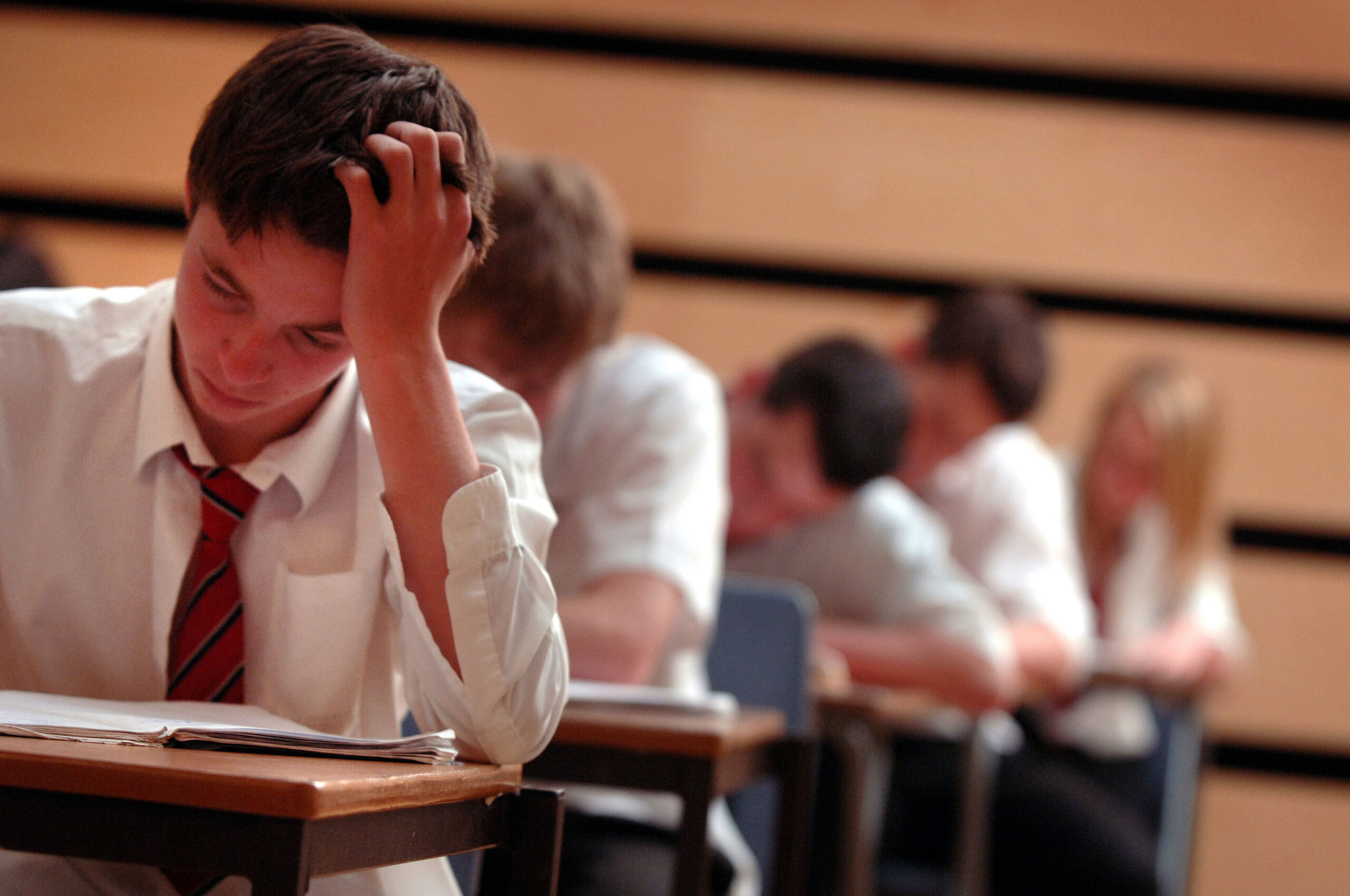
Alamy: A36PMP School pupils in exam conditions in a school hall. For illustrative purposes only.
Is it time to ditch scripted lessons and heavily-packed curricula to focus on individual student growth?
This is the question posed by education expert Geoff Masters, who argues that age-based expectations are not serving all children well, while scripted lessons are failing teachers and students alike.
Masters, the former head of the Australian Council for Educational Research, asks how well children are served by a system in which two pupils in the same class can differ by six or more years of learning but are taught the same material.
He argues this system fails children at either end of the scale – those who are struggling and those who are unchallenged. He asks what if, instead of holding all pupils of the same age to the same learning expectations, we based expectations on where individuals are in their comprehension and individual growth.
“Too many students in our schools are being poorly served and left behind by machineries of schooling not fit for purpose,” Masters warns.
The problem with standardisation
Masters argues there is a fundamental flaw in the current system: the assumption that all students in the same grade are equally ready to learn the same material.
Research shows that children in the same classroom can have up to a seven-year difference in their reading and mathematics comprehension. This vast variation, Masters argues, is ignored by a system that prioritises standardisation over individual needs.
“By the middle years of school, many students have not learnt what the curriculum expected them to learn much earlier in their schooling,” Masters explains. He cites data showing how, across 38 developed countries, almost a third of 15-year-olds have difficulty demonstrating 5th and 6th grade mathematics content.
The picture in Australia
Masters’ arguments are presented against a backdrop of Australia’s declining performance in international assessments like PISA. Between 2012 and 2022, there was no significant improvement in Australian students’ performances in reading, mathematics or science. In fact, long-term declines have been recorded across all three areas.
“Despite decades of reforms, the machinery of schooling has not delivered the improvements we need,” Masters says. “It’s time to question whether prescribing what every student must learn in each grade of school and testing to see whether they have learnt it is the best way to optimise learning and improve performance.”
Masters also explains how those who start the year behind are likely to stay behind. He explains: “When the curriculum expects all students in a grade to be taught the same content at the same time, those who begin well below grade level are disadvantaged. This disadvantage is compounded when students are required to move from one grade curriculum to the next based on elapsed time rather than mastery. Students who lack essential prerequisites often fall further behind as each grade’s curriculum becomes increasingly beyond their reach.”
The future of learning
Masters instead argues for a system that meets students where they are in their learning, rather than where their age or grade dictates they should be. He proposes replacing age-based expectations with personalised learning plans that track individual growth.
“Improved performance depends on meeting each student where they are with personally meaningful, well-targeted learning opportunities that build on what they already know,” Masters explains. “This approach includes all students, including neurodiverse children and others with special needs.”
This approach would not only benefit students, he suggests, but also empower teachers to use their professional expertise to design tailored learning experiences.
One of the most concerning trends in education, in Masters’ view, is the rise of scripted lessons.
“Scripted lessons turn teaching into the delivery of ready-made solutions created outside the classroom,” Masters says. “They undervalue teachers’ expertise in what is arguably the essence of effective teaching: establishing where individuals are in their learning and designing opportunities to promote further growth.”
Masters calls for a return to professional autonomy, where teachers are trusted to make decisions in the best interests of their students.
Masters envisions a future where education systems embrace diversity and difference.
“Rather than expecting students to fit the expectations of schooling, the challenge is to redesign school structures and processes to better meet the needs of individual learners,” Masters concludes.